


“Automated AI-based identification of autism spectrum disorder from home videos” (published in NPJ Digital Medicine, Oct 2025) Life Science Network:
https://www.nature.com/articles/s41746-025-01993-5
Background
- Autism spectrum disorder (ASD) is a common neurodevelopmental condition.
- Early diagnosis is critical but often delayed due to:
- Long, resource-intensive assessments
- Need for specialist expertise
- Limited accessibility in many regions
- Home videos have been explored for screening, but manual coding is labor-intensive and inconsistent.
Study Design
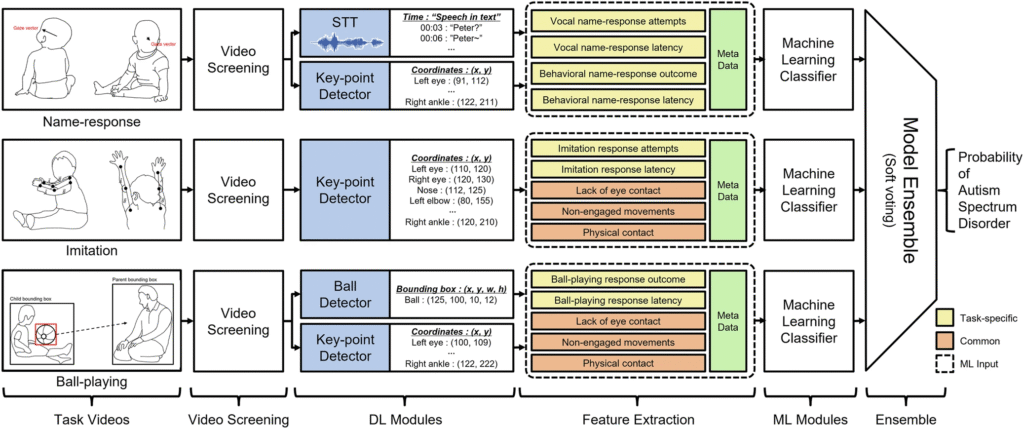
- Researchers developed a fully automated AI-based screening system using short, structured home video tasks.
- Participants: 510 children (253 with ASD, 257 typically developing), aged 18–48 months, recruited from 9 hospitals in South Korea.
- Video protocols (each <1 min):
- Name-response task
- Imitation task
- Ball-playing task
- Data processing:
- Deep learning models extracted task-specific behavioral features.
- Combined with demographic data.
- An ensemble machine learning classifier integrated these inputs.
Key Findings
- Performance:
- AUC (Area Under ROC): 0.83
- Accuracy: 0.75
- The system reliably distinguished ASD from typically developing children using only short home videos.
- Automated analysis reduced reliance on manual coding, improving scalability and consistency.
Implications
- Clinical utility: Can complement traditional diagnostic evaluations.
- Accessibility: Enables earlier screening in resource-limited settings.
- Practicality: Short, naturalistic tasks make it feasible for parents to record at home.
- Future potential: Could help prioritize referrals and support earlier intervention.
In essence: This study demonstrates that a brief, structured, AI-driven analysis of home videos can identify early signs of autism with good accuracy, offering a scalable tool to support earlier detection and intervention.
Content created by copilot GPT-5
