


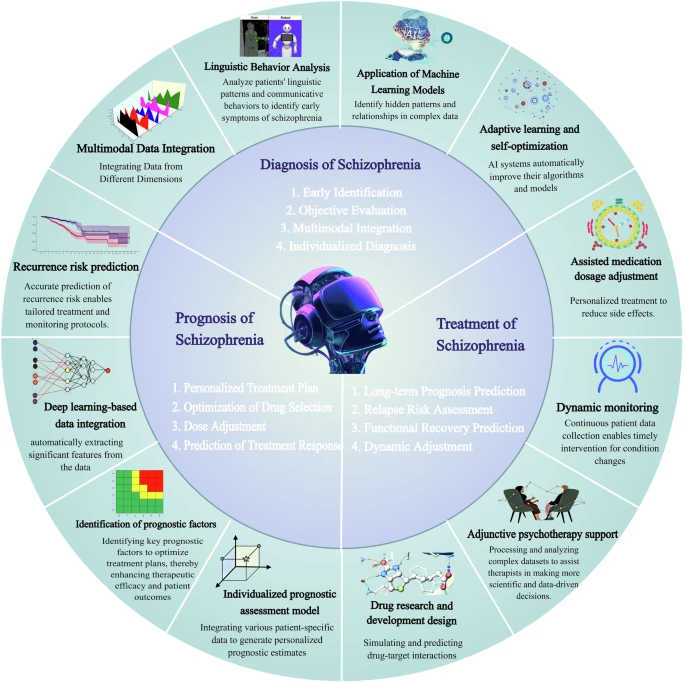
“Can artificial intelligence be the future solution to the enormous challenges and suffering caused by Schizophrenia?” (Nature Schizophrenia, 2025):
https://www.nature.com/articles/s41537-025-00583-4
- To evaluate how artificial intelligence (AI) can address the diagnostic, therapeutic, and prognostic challenges of schizophrenia (SZ).
- To explore future directions for integrating AI into psychiatry and collaborative medical innovation.
Aim of the Paper
To explore future directions for integrating AI into psychiatry and collaborative medical innovation.
To evaluate how artificial intelligence (AI) can address the diagnostic, therapeutic, and prognostic challenges of schizophrenia (SZ).
Background
- Schizophrenia is a severe, chronic mental disorder with:
- High global burden of disease.
- Significant suffering for patients and families.
- Persistent challenges in early detection, treatment resistance, and relapse prevention.
- Current approaches rely heavily on subjective clinical assessments, which are often inconsistent and resource-intensive.
Key Findings
- Diagnosis:
- AI (especially machine learning and deep learning) can analyze multimodal data (neuroimaging, genetics, voice, digital behavior, clinical records).
- Promising results in early identification of high-risk individuals and reducing misdiagnosis.
- Treatment:
- AI models can predict treatment response and help tailor personalized interventions.
- Potential to optimize antipsychotic selection and monitor adherence.
- Prognosis:
- AI can forecast relapse risk and long-term outcomes, enabling proactive care.
- Collaborative Potential:
- Integration of AI with digital health platforms, wearables, and telepsychiatry could expand access to care.
Challenges & Ethical Considerations
- Data quality and heterogeneity: Variability in datasets limits generalizability.
- Bias and fairness: Risk of reinforcing health inequities if training data are unrepresentative.
- Privacy and consent: Sensitive psychiatric data require robust safeguards.
- Clinical translation: Moving from research prototypes to real-world, regulated tools remains a major hurdle.
Significance
- AI is not a cure, but it offers transformative potential to:
- Improve precision psychiatry.
- Reduce delays in diagnosis.
- Support personalized, continuous care.
- The authors argue that multidisciplinary collaboration (psychiatrists, data scientists, ethicists, patients) is essential for safe and effective adoption.
In short: The paper concludes that AI could become a future cornerstone in schizophrenia care, provided that ethical, technical, and clinical challenges are addressed through rigorous research and collaborative innovation.
Content created by Copilot GPT-5
