


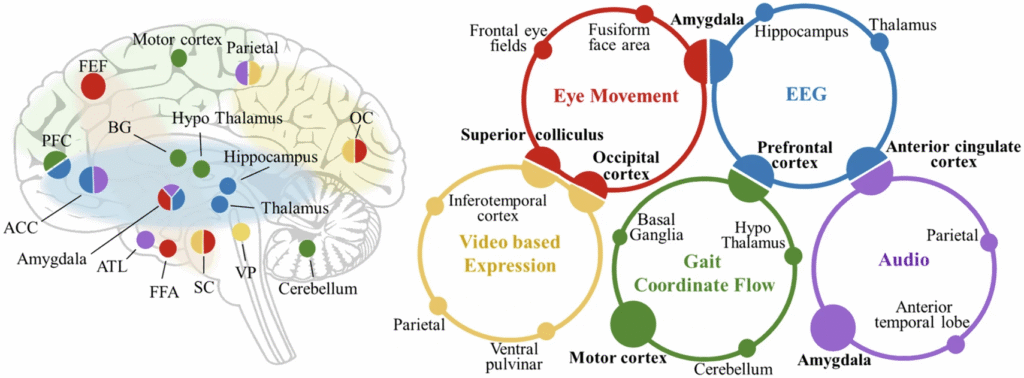
Brain activation patterns in depression across key functional domains, including altered emotional processing, negative attentional bias, delayed auditory responses, and impaired sensorimotor-emotional integration. BG Basal Ganglia, ATL Anterior Temporal Lobe, FFA Fusiform Face Area, VP Ventral Pallidum, SC Superior Colliculus, OC Occipital Cortex.
“AI-assisted multi-modal information for the screening of depression: a systematic review and meta-analysis”:
https://www.nature.com/articles/s41746-025-01933-3
Background
- Depression is one of the most common and disabling mental health conditions worldwide.
- Traditional screening relies on self-report questionnaires and clinical interviews, which can be subjective, time-consuming, and prone to under-detection.
- AI-assisted approaches using multi-modal data (e.g., voice, facial expression, EEG, heart rate, text, and behavior) are emerging as promising tools for more objective and scalable screening.
Methods
- The authors conducted a systematic review and meta-analysis of published studies applying AI to depression screening.
- Modalities included:
- Physiological: EEG, heart rate variability, neuroimaging signals.
- Behavioral: speech, facial expression, eye-tracking, gait, smartphone usage.
- Multi-modal fusion: combining two or more data streams.
- Extracted and pooled classification performance metrics: accuracy, sensitivity, specificity, AUC.
Key Findings
- Overall performance: AI-assisted methods showed good discriminatory ability for identifying depression.
- Multi-modal models consistently outperformed single-modality approaches.
- EEG + behavioral data combinations yielded the highest accuracy.
- Voice and facial expression analysis were particularly promising for non-invasive, real-world screening.
- Heterogeneity: Results varied depending on dataset size, feature extraction, and AI algorithms.
- Limitations: Many studies had small samples, lacked external validation, and risked overfitting.
Implications
- AI-assisted multi-modal screening could:
- Enable early detection of depression in both clinical and community settings.
- Provide objective, scalable, and low-burden tools to complement clinician judgment.
- Reduce reliance on self-report measures.
- To move toward clinical translation, the field needs:
- Larger, diverse, and representative datasets.
- Standardized protocols for data collection and model evaluation.
- Ethical safeguards for privacy, bias, and transparency.
- Regulatory validation before deployment.
Conclusion
AI-assisted multi-modal information is a promising frontier for depression screening.
- Fusion models (combining physiological and behavioral data) show the strongest potential.
- However, the field is still in its early stages, and robust validation is essential before integration into routine practice.
Content created by Copilot GPT-5
