


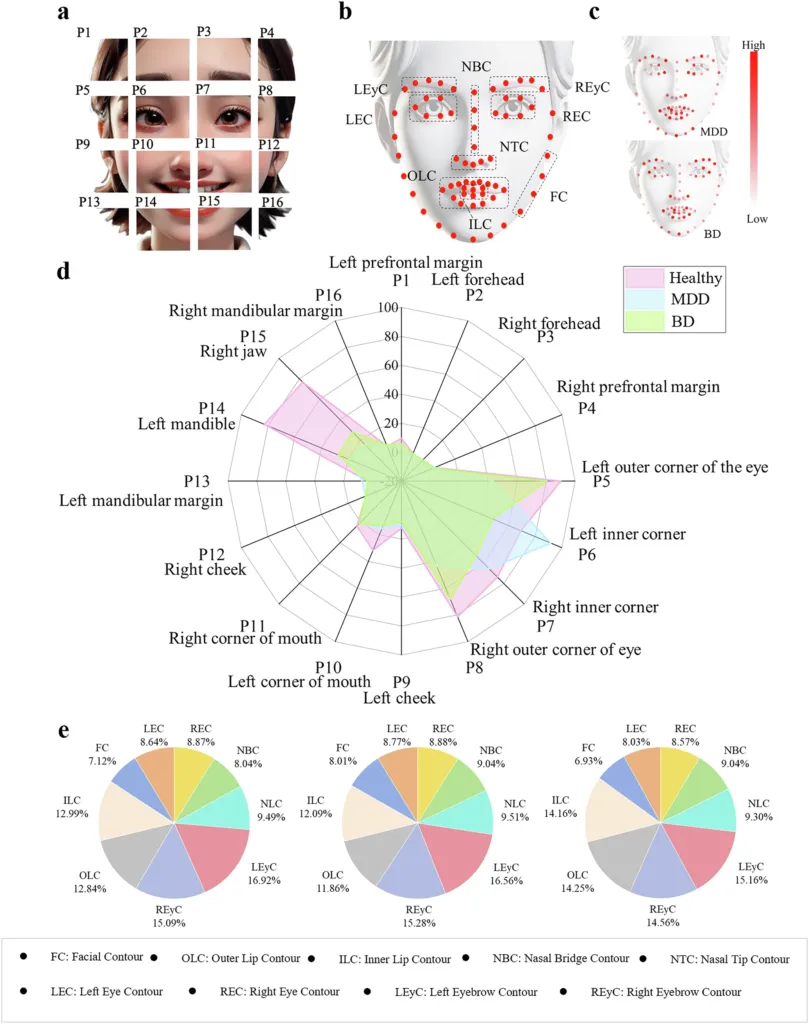
“Emoface: AI-assisted diagnostic model for differentiating major depressive disorder and bipolar disorder via facial biomarkers”:
https://www.nature.com/articles/s44184-025-00164-4
Purpose
- To address the long-standing diagnostic challenge of distinguishing Major Depressive Disorder (MDD) from Bipolar Disorder (BD), especially during depressive episodes where symptoms overlap.
- Misdiagnosis is common and delays appropriate treatment, so the study explores whether facial biomarkers analyzed by AI can provide objective differentiation.
Methodology
- Participants: Patients with MDD, BD, and healthy controls.
- Data Collection: Standardized facial videos/images were captured during emotional tasks.
- AI Model:
- Built on facial keypoint detection and biomarker extraction.
- Used machine learning classifiers (e.g., ensemble methods) to analyze subtle differences in facial expressions, micro-movements, and emotion dynamics.
- Validation: Cross-validation and external test sets ensured robustness.
Key Findings
- Diagnostic Accuracy: The Emoface model achieved high sensitivity and specificity in distinguishing MDD from BD, outperforming traditional clinical assessments alone.
- Facial Biomarkers:
- MDD patients showed reduced expressivity and slower emotional reactivity.
- BD patients displayed greater variability and distinct micro-expression patterns.
- Efficiency: The model provided rapid, non-invasive, and scalable diagnostic support.
Implications
- Clinical Impact: Could serve as an adjunct tool for psychiatrists, reducing misdiagnosis and guiding earlier, more tailored interventions.
- Scalability: Potential for integration into telepsychiatry and mobile health platforms.
- Ethical Considerations: Raises questions about privacy, consent, and algorithmic bias in psychiatric diagnostics.
Future Directions
- Larger, more diverse datasets to improve generalizability.
- Integration with multimodal biomarkers (speech, neuroimaging, physiological signals).
- Exploration of real-world deployment in clinical and community settings.
In short: Emoface demonstrates that AI can detect subtle facial expression differences between MDD and BD, offering a promising step toward objective, scalable psychiatric diagnostics.
Content created by Copilot GPT-5
